

REINVENT INSULATOR
Biomimetic Dual-Action Hair Reconstruction & Nano-Polymeric Protection
Advanced Biomimetic Technology for Functional Hair Fibre Restoration, Reinforcement and Protective Coating
Heat & Sunlight-Responsive Polymeric Microemulsion Technology
Scientific Abstract
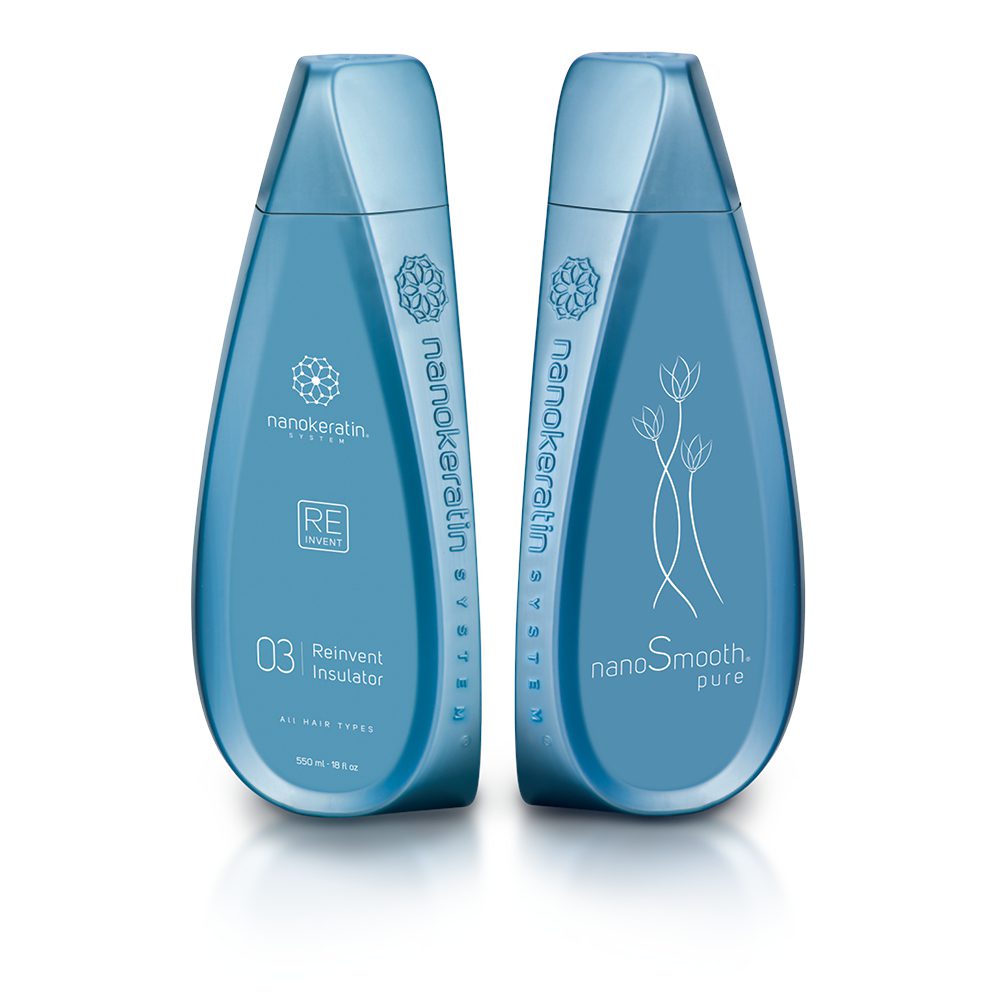
REINVENT INSULATOR, developed by Nanokeratin System Laboratories, introduces a multifunctional hair care concept integrating functional hair fibre restoration with the formation of a protective polymeric coating.
The technology is designed around two complementary objectives: improving the mechanical and cosmetic characteristics of damaged hair and establishing a protective interface between the hair fibre and external environmental stressors.
The technological framework draws upon biomimicry, hair fibre science, polymer chemistry and advanced dispersion systems.
At the centre of this concept is a polymeric microemulsion system intended to facilitate the distribution of functional ingredients and support their interaction with the hair fibre surface.
The formulation concept also incorporates heat-responsive behaviour and Nanokeratin System’s proprietary Sunlight Phototherapy approach, which proposes the use of natural sunlight as an additional factor influencing the performance of the cosmetic system.
Together, these principles establish a dual-action technological approach addressing existing hair fibre damage whilst supporting protection against subsequent thermal, mechanical and environmental exposure.
The proposed mechanisms are scientifically plausible within the broader fields of cosmetic polymer science and hair surface engineering. Their specific effectiveness, however, requires experimental validation using the finished formulation.
Keywords: Biomimicry, Hair Fibre Reconstruction, Polymeric Microemulsion, Nano-Polymeric Protection, Heat-Responsive Polymers, Sunlight Phototherapy, Hair Surface Engineering, Colour Vibrancy.
1. REINVENT INSULATOR: A New Approach to Hair Treatment and Protection
Human hair is continuously exposed to thermal, chemical, mechanical and environmental stressors.
Repeated exposure to hairdryers, straighteners, curling appliances, bleaching treatments, colouring procedures and sunlight can affect the structural integrity of the hair cuticle and alter the mechanical properties of the hair fibre.
Such changes may manifest as increased breakage, dryness, surface roughness, split ends, diminished shine and greater sensitivity to atmospheric humidity.
Traditional cosmetic conditioning systems frequently concentrate on improving the immediate appearance and manageability of the hair.
REINVENT INSULATOR has been developed around a broader technological concept integrating functional fibre restoration with surface protection.
The system is intended to address two complementary objectives.
The first involves improving the functional characteristics of the existing hair fibre, particularly where its mechanical and cosmetic properties have been compromised.
The second involves establishing a polymeric coating designed to reduce direct interaction between the hair surface and external stressors.
This dual-action approach recognises that the performance of a hair care system depends not only on its ability to improve the condition of damaged hair but also on the characteristics and durability of the protective layer it creates.
2. Biomimetic Hair Fibre Reconstruction
2.1 The Scientific Principles of Biomimicry
Biomimicry involves developing materials and functional systems inspired by naturally occurring biological structures and processes.
Within cosmetic science, biomimetic principles can be applied to the design of conditioning polymers, protective films and materials intended to interact with biological surfaces.
Human hair is a complex keratinised fibre consisting principally of the cuticle, cortex and, in some fibres, a medulla.
The cuticle forms the outer protective region of the hair shaft and plays an important role in surface friction, shine, moisture interactions and resistance to external damage.
The cortex provides much of the hair fibre’s mechanical strength and elasticity.
Chemical treatments, elevated temperatures and repeated mechanical stress can affect these structures and their associated properties.
2.2 Functional Reconstruction Versus Biological Regeneration
The REINVENT INSULATOR concept focuses on functional reconstruction rather than biological regeneration.
The visible hair shaft consists of non-living keratinised material.
Consequently, cosmetic products cannot biologically regenerate the existing hair shaft in the same manner as living tissue.
However, appropriately designed cosmetic systems may improve selected physical properties of damaged hair through surface modification, conditioning, film formation and interactions with hair proteins.
These effects may contribute to improvements in smoothness, manageability, frictional behaviour and resistance to grooming-related damage.
2.3 The Proposed Biomimetic Mechanism
The biomimetic approach underlying REINVENT INSULATOR is intended to support the functional performance of compromised hair fibres.
Its proposed functions include improving surface uniformity, reducing friction between adjacent fibres and supporting the formation of a protective polymeric interface.
The extent to which these functions occur depends on the composition of the formulation and the nature of its interaction with the hair surface.
3. Advanced Polymeric Microemulsion Technology
3.1 The Role of Dispersion Systems in Cosmetic Formulations
The performance of a cosmetic formulation depends partly on the distribution, availability and interactions of its constituent ingredients.
Microemulsions are specialised dispersion systems that may offer advantages in the incorporation and distribution of selected formulation components.
A scientifically defined microemulsion is generally characterised by a thermodynamically stable, isotropic system containing appropriate combinations of oil, water and surface-active components.
Not every finely dispersed cosmetic emulsion meets this definition.
The classification of a finished formulation therefore requires appropriate physicochemical characterisation.
3.2 The REINVENT INSULATOR Microemulsion Concept
REINVENT INSULATOR incorporates a polymeric microemulsion concept designed to improve the distribution of functional ingredients and support their interaction with the hair fibre.
The intended technological advantages include more uniform ingredient distribution, controlled surface interaction and the development of a consistent protective coating.
The behaviour of the system will depend on its specific polymer chemistry, dispersion characteristics, surface affinity and application conditions.
3.3 Interaction with the Hair Fibre
The outer surface of human hair exhibits chemical and physical characteristics that influence the deposition of cosmetic ingredients.
Hair surface charge, hydrophobicity, porosity and the extent of previous chemical damage can affect the interaction between the fibre and conditioning materials.
Polymers may adhere to the hair surface through several mechanisms, including electrostatic interactions, hydrogen bonding, hydrophobic interactions and physical film formation.
The relative importance of these mechanisms depends on the specific chemical composition of the formulation.
The REINVENT INSULATOR concept is intended to utilise controlled ingredient distribution and polymeric surface interactions to support its dual-action functionality.
4. Dual-Action Hair Reconstruction and Nano-Polymeric Protection
4.1 Functional Hair Fibre Restoration
The first component of the dual-action concept concerns the functional restoration of damaged hair.
Chemical and physical damage can increase cuticle irregularity, alter fibre friction and reduce resistance to mechanical stress.
Cosmetic conditioning systems may improve these characteristics by modifying the fibre surface and reducing friction during combing and styling.
REINVENT INSULATOR is designed to support these functions through its polymer-based formulation concept.
4.2 Protective Polymeric Film Formation
The second component involves the formation of a protective polymeric coating.
Film-forming polymers are widely used in cosmetic formulations because they can modify surface characteristics and create a physical interface between the substrate and its surroundings.
On the hair fibre, such coatings may contribute to smoother surfaces, enhanced shine and improved manageability.
Depending on the polymer chemistry, they may also influence moisture interactions and the fibre’s response to environmental conditions.
4.3 Nano-Polymeric Protection
The term nano-polymeric protection describes the technological positioning of the REINVENT INSULATOR protective coating concept.
However, confirmation of nanoscale characteristics requires measurements demonstrating the relevant structural dimensions.
A nanoscale ingredient, dispersion droplet or polymeric structure should not be assumed solely from the product’s technological designation.
The scientific evaluation of the coating should therefore distinguish its chemical composition, structural dimensions, surface coverage and protective performance.
4.4 Coating Uniformity and Durability
A protective coating’s effectiveness depends on more than its initial formation.
Relevant parameters include surface coverage, adhesion, resistance to mechanical removal, response to humidity and durability following repeated washing.
A coating that improves immediate smoothness may not necessarily provide prolonged protection.
Accordingly, the durability of the REINVENT INSULATOR protective layer should be established through controlled experimental testing.
5. Heat-Responsive Polymeric Technology
5.1 Thermal Behaviour of Cosmetic Polymers
Temperature can influence the physical behaviour of polymers used in cosmetic formulations.
Depending on their molecular structure and formulation environment, polymeric materials may exhibit changes in mobility, viscosity, adhesion, film formation and mechanical behaviour as temperature increases.
These characteristics are relevant to hair care products designed for use alongside heated styling appliances.
5.2 Heat-Responsive Film Formation
The REINVENT INSULATOR concept incorporates heat-responsive polymeric behaviour as part of its proposed coating technology.
Within this framework, controlled thermal exposure is intended to influence the distribution or performance of the polymeric system.
The proposed mechanism may involve temperature-dependent changes in the physical characteristics of the formulation or deposited coating.
The exact mechanism cannot be established without formulation-specific thermal and structural analysis.
5.3 The Relationship with SoftSmooth & ReSmooth
The SoftSmooth & ReSmooth technology platform provides a complementary context for examining hair smoothness, manageability and the cosmetic effects of surface modification.
Within the broader Nanokeratin System technological framework, these concepts can be discussed alongside polymeric conditioning and fibre surface engineering.
However, their relationship to REINVENT INSULATOR should be defined according to the actual formulations and documented mechanisms rather than assuming that all products employ identical chemistry.
5.4 Thermal Protection and Scientific Validation
Heat responsiveness and thermal protection are related but scientifically distinct concepts.
A formulation may undergo temperature-dependent physical changes without necessarily preventing heat-induced hair damage.
Claims concerning thermal protection require comparative testing under defined exposure conditions.
Relevant measurements may include changes in tensile strength, fibre morphology, protein structure, surface friction and breakage following controlled thermal treatment.
The protective performance of REINVENT INSULATOR should therefore be evaluated separately from its proposed heat-responsive behaviour.
6. Sunlight Phototherapy: Light-Responsive Hair Care Technology
6.1 The Role of Light in Material Science
Light-responsive materials are an established area of materials science.
Certain molecular structures can undergo photochemical or photophysical changes when exposed to specific wavelengths of electromagnetic radiation.
These changes may affect material properties, molecular configuration or chemical reactivity.
However, such responses are highly dependent on the chemical composition of the material and the wavelength, intensity and duration of light exposure.
6.2 The Nanokeratin System Sunlight Phototherapy Concept
Nanokeratin System’s Sunlight Phototherapy concept proposes the use of natural sunlight as an additional influence on the performance of its cosmetic technology.
Within the REINVENT INSULATOR framework, this concept is associated with the proposed light-responsive behaviour of the polymeric system.
The intended objective is to integrate sunlight exposure into the broader technological approach to hair fibre treatment and protection.
This concept should be distinguished from established medical phototherapy.
In this article, Sunlight Phototherapy is used exclusively as the name of a cosmetic technology concept.
6.3 Proposed Light-Activation Mechanism
A scientifically demonstrable light-activation mechanism requires a measurable change in material behaviour resulting from controlled light exposure.
Depending on the formulation, relevant changes might involve film characteristics, molecular interactions or other measurable physical properties.
Such effects cannot be attributed to REINVENT INSULATOR without direct experimental evidence.
To validate the proposed mechanism, testing should compare treated hair under controlled illumination with equivalent samples maintained under otherwise identical conditions without illumination.
The experimental design should also account for temperature changes caused by light exposure.
This distinction is important because an apparent response to sunlight may result from heating rather than a specific photochemical mechanism.
6.4 Natural Sunlight and Hair Protection
Sunlight contains a range of wavelengths, including ultraviolet, visible and infrared radiation.
Prolonged ultraviolet exposure can contribute to changes in hair proteins, pigments and surface characteristics.
Consequently, any proposed sunlight-responsive hair care system should be evaluated for both its intended functional response and its capacity to maintain hair fibre integrity under relevant exposure conditions.
The presence of a light-responsive mechanism does not automatically establish ultraviolet protection.
7. Colour Vibrancy and Hair Fibre Surface Protection
7.1 The Relationship Between Hair Colour and Fibre Condition
The appearance of coloured hair depends on several interacting factors, including pigment composition, cuticle condition, surface smoothness and the optical characteristics of the fibre.
Chemical colouring processes may alter the cuticle and influence hair porosity.
Repeated washing, environmental exposure and thermal styling can contribute to changes in colour appearance over time.
7.2 Surface Smoothness and Light Reflection
The visual appearance of hair is influenced by the interaction between incident light and the fibre surface.
A smoother, more uniform surface can support more regular light reflection and contribute to the perception of shine.
Conversely, irregular surface structures may increase diffuse light scattering and reduce the appearance of gloss.
Polymeric conditioning systems can influence these optical characteristics through surface modification.
7.3 The Proposed Role of REINVENT INSULATOR
Within the dual-action technological framework, the proposed polymeric coating may contribute to maintaining a smoother hair surface.
Such surface modification could influence the visual appearance of coloured hair by improving gloss and reducing roughness.
However, enhanced shine should not be equated with proven prevention of pigment loss.
Colour retention requires specific evaluation using appropriately controlled colour measurements and repeated washing or exposure protocols.
7.4 Colour Vibrancy as a Complementary Technology
The Colour Vibrancy platform provides an additional context for examining the relationship between hair fibre condition, surface protection and the visual quality of coloured hair.
Its specific technological relationship to REINVENT INSULATOR requires confirmation from the relevant formulation and product documentation.
8. Integrated Technological Framework
REINVENT INSULATOR is positioned as a multifunctional cosmetic technology integrating several complementary scientific principles.
These can be organised into three primary functional systems.
8.1 Biomimetic Functional Restoration
The first system focuses on improving selected mechanical and cosmetic properties of damaged hair.
Its proposed effects involve surface conditioning, improved manageability and reduced friction.
8.2 Polymeric Surface Protection
The second system concerns the deposition and formation of a protective polymeric coating.
This coating is intended to modify the interaction between the hair fibre and its external environment.
Its functional performance depends on adhesion, uniformity, material properties and durability.
8.3 Heat- and Sunlight-Responsive Behaviour
The third system incorporates the proposed response of the polymeric formulation to thermal and natural light exposure.
These environmental factors are presented as potential influences on the behaviour of the cosmetic system.
Their respective contributions must be investigated independently to distinguish thermal effects from genuine light-dependent mechanisms.
8.4 The Combined Dual-Action Concept
The integration of these three systems forms the basis of the REINVENT INSULATOR technological proposition.
The intended result is a multifunctional cosmetic approach that addresses existing fibre condition whilst supporting protective surface modification.
The effectiveness of the integrated system must be demonstrated through testing of the complete formulation rather than inferred solely from the known properties of individual ingredients.
9. Scientific Evaluation and Validation Framework
9.1 Mechanical Performance
Mechanical testing can help determine whether a treatment influences the functional characteristics of damaged hair.
Relevant methods include tensile strength measurements, elongation testing, repeated grooming assessments and controlled breakage studies.
Comparisons should include untreated controls and, where appropriate, relevant reference formulations.
9.2 Surface Morphology
Microscopic techniques can be used to examine changes in hair surface characteristics.
Scanning electron microscopy and other suitable imaging methods may provide information about cuticle morphology and surface modification.
However, visual changes alone do not establish improved mechanical strength or long-term protection.
9.3 Surface Friction and Manageability
Instrumental friction testing and standardised combing-force measurements can help quantify changes in hair manageability.
These methods are particularly relevant to evaluating polymeric conditioning systems and surface coatings.
9.4 Polymeric Coating Characterisation
The proposed protective coating should be characterised using methods appropriate to its chemistry and physical structure.
Relevant parameters include surface coverage, coating thickness, adhesion and resistance to removal.
If nanoscale characteristics are claimed, suitable analytical measurements should establish the relevant dimensions.
9.5 Thermal Performance
Thermal testing should compare treated and untreated hair following standardised exposure to elevated temperatures.
Measurements should distinguish changes in styling performance from genuine reductions in heat-induced damage.
9.6 Light-Responsive Performance
The proposed Sunlight Phototherapy mechanism requires controlled exposure studies.
10. Scientific conclusions
The scientific literature supports the importance of hair-fibre surface protection, conditioning and management of cumulative environmental and styling stress. The manufacturer’s proposed combination of biomimetic recuperation, light-responsive activation and nano-polymeric protection offers a coherent research hypothesis and differentiated product positioning. However, the mechanism and efficacy of Reinvent Insulator, and its precise relationship to SoftSmooth ReSmooth and Colour Vibrancy, must be verified with product-specific analytical and performance data before being presented as established findings.
11. Scope and scientific disclaimer
This publication is a technology review, not a clinical trial or a report of original product-testing results. Descriptions of proprietary technologies are identified as manufacturer positioning. No independent confirmation is claimed for molecular reconstruction, sunlight-triggered activation, thermal-protection thresholds, dye retention or synergy between product platforms. The linked company technology pages provide the manufacturer’s descriptions of the proprietary platforms. These descriptions do not constitute independent experimental validation.
Technology references and further reading
- SoftSmooth ReSmooth | Official technology page
- Colour Vibrancy | Official technology page
- Sunlight Phototherapy | Official technology page
- Hair-care physicochemistry: structure, degradation and conditioning (2023)
- Mechanism of cuticle-hole development following UV exposure (2018)
- Photo-damage of human hair (2006)